
With AI writing specs, writing code, debugging code, etc., user interfaces (UI) become irrelevant.
In my opinion, UI-based debugging, perf analysis, etc. will probably be replaced with MCP servers and modifying the code to inject trace points that AI can read. AI can already do a pretty good at debugging the way humans did before we had debuggers, just by adding Console.WriteLine at places.
I suspect software engineering as we do today will be relegated to hobbyists, the way ham radio operators exist out there among people who like to work low-level like that, even though social media and video sharing is easier and worldwide. Manually writing code will be prohibitively expensive for companies compared to using AI to do it. And the college hires that they can afford today, that know how to drive AI, will not be promoted to senior engineer pay levels because they can’t add that much more value above AI. Instead, like baggers at a grocery store check stand, people who drive AI may be low-skill people who are easily replaced, such that paying an experienced person much more than a new hire won’t be necessary or justified (from the company’s perspective).
Now exactly how and when this plays out, and what today’s engineers do during the transition, I can’t clearly map. But I expect it’s something like this:
- Engineers will be much more productive, or they’ll be laid off.
- Companies will seek a new balance between more productivity boosting competition in the marketplace, and reducing costs through layoffs.
- The engineers who remain will focus their time on increasingly complex problems and/or orchestrating AI to solve the simpler problems.
- AI gets better, pushing the boundary on what engineers have to focus on to smaller and smaller fractions of what they do today.
- PMs use AI to build products, and software engineering is restricted to hobbyists.
- AI replaces PMs by hooking up to social media, reading feedback and orchestrating AI to change software to respond to it.
- Since every company with just executives and even individuals w/o an engineering education can do this, software itself becomes commoditized.
- Like mobile apps did to desktop apps, consumers get a much larger selection of apps which are smaller and more focused, with a lot of junk and a few gems available to choose from since anyone can build one.
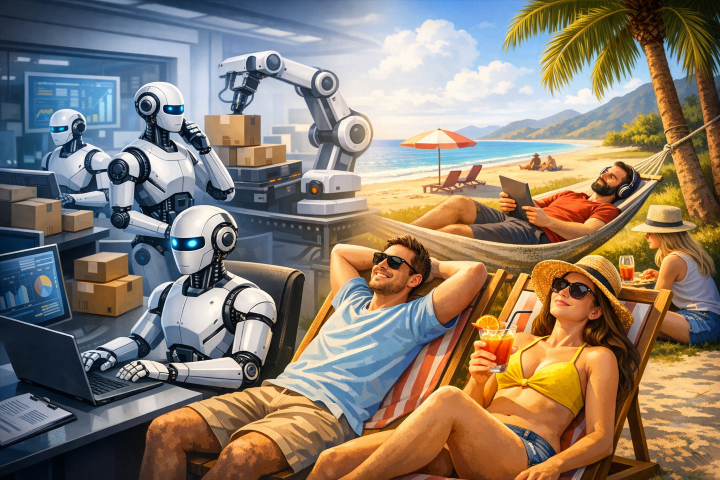
I might say that with AI taking over ever-more of the software engineering and information worker jobs, that in a humorous twist of fate, the safest jobs are the physical labor ones that computers can’t replace. But machines have always threatened such jobs, and with AI powered robots like Optimus under development even personal physical labor that requires a fine touch may become something that humans only do if they like the activity within our lifetimes.
As a fiscal conservative, I haven’t particularly liked the idea of a universal basic income, as it felt too communist/socialist. But in a world where all our basic needs really are met by machines, when jobs are perhaps scarce and people can focus on what they enjoy, maybe it makes sense.